


 A strong Video Marketing Strategy for Businesseszzcan help brands attract attention, build trust, engage customers, and increase conversions. With people consuming video content on platforms such as Instagram, YouTube, Facebook, and LinkedIn, businesses can use video to communicate their message in a simple and engaging way.
Today, video marketing has become one of the most powerful ways for businesses to connect with their target audience. Instead of depending only on text-based advertisements or static images, brands can use videos to demonstrate their products, explain their services, tell stories, answer customer questions, and create memorable experiences.
What Is a Video Marketing Strategy for Businesses?
A Video Marketing Strategy for Businesses is a planned approach to creating, publishing, and promoting video content to achieve specific marketing goals. These goals can include increasing brand awareness, generating leads, promoting products, improving website traffic, increasing sales, or building stronger relationships with customers.
A successful video marketing strategy is not simply about creating attractive videos. Businesses need to understand their audience, choose the right platforms, create valuable content, and measure performance regularly.
For example, a fashion brand may create styling videos, product demonstrations, customer testimonials, and behind-the-scenes content. Similarly, a digital marketing agency can create educational videos about SEO, social media marketing, content marketing, and online advertising.
Why Is Video Marketing Important for Businesses?
Video content is highly engaging because it combines visuals, audio, storytelling, and emotions. This makes it easier for audiences to understand and remember information.
One of the biggest advantages of video marketing is that it can capture attention quickly. People often scroll through social media feeds rapidly, so businesses need content that can make users stop and watch. A well-designed video can communicate the main message within a few seconds.
Video marketing can also help businesses build trust. Customers can see products in action, hear real customer experiences, and understand how a service works before making a purchasing decision.
Another important benefit is increased engagement. Videos can encourage users to like, comment, share, save, or visit a website. When people interact with video content, businesses have more opportunities to develop relationships with potential customers.
Set Clear Goals for Your Video Marketing Strategy
 Before creating videos, businesses should define their objectives. A clear goal helps determine what type of videos should be created and where they should be published.
Some common video marketing goals include:
- Increasing brand awareness
- Generating leads
- Increasing website traffic
- Promoting a product or service
- Educating customers
- Increasing social media engagement
- Building customer trust
- Improving conversion rates
- Increasing online sales
For example, if the goal is brand awareness, short entertaining videos may be effective. If the goal is generating leads, businesses can create educational videos with a strong call-to-action directing viewers to a landing page.
Understand Your Target Audience
 Understanding the target audience is one of the most important parts of a Video Marketing Strategy for Businesses. A video should be created for a specific group of people rather than trying to reach everyone.
Businesses should understand their audience’s age, interests, problems, preferences, online behavior, and purchasing decisions.
For example, a business targeting young customers may focus on Instagram Reels, YouTube Shorts, and other short-form video platforms. A B2B company may focus more on LinkedIn and YouTube.
When businesses understand what their audience wants to watch, they can create videos that are more relevant and valuable.
Choose the Right Video Content
 There are many different types of video content businesses can use. Choosing the right format depends on the marketing objective and target audience.
Product Demonstration Videos
Product videos show customers how a product works and explain its key features. These videos are particularly useful for e-commerce businesses because customers can understand the product before purchasing it.
Educational Videos
Educational videos provide useful information to the audience. Businesses can answer common questions, explain industry topics, provide tutorials, and share useful tips.
Educational content can also help establish a brand as an authority in its industry.
Customer Testimonial Videos
Customer testimonials are powerful because they provide social proof. Instead of the company simply saying that its product is good, real customers can share their experiences.
This can increase credibility and help potential customers feel more confident about making a purchase.
Behind-the-Scenes Videos
Behind-the-scenes videos show the people and processes behind a business. They can make a brand feel more human and authentic.
Businesses can show how products are created, how employees work, how an office operates, or how a campaign is developed.
Short-Form Videos
Short-form videos have become extremely popular on platforms such as Instagram, YouTube, and Facebook. Businesses can use short videos to share quick tips, product highlights, trends, educational information, and entertaining content.
Create High-Quality but Authentic Videos
High-quality video does not always mean expensive production. Businesses can create effective videos using smartphones, good lighting, clear audio, and simple editing tools.
The most important factor is the value of the content. A professionally produced video may not perform well if it does not provide something useful or interesting to the audience.
Businesses should focus on:
- Clear audio
- Good lighting
- Strong visuals
- Simple messaging
- Attractive thumbnails
- Engaging introductions
- Consistent branding
- Clear calls-to-action
Authenticity is also important. Audiences often prefer genuine and relatable content rather than videos that feel overly promotional.
Create Strong Video Hooks
The first few seconds of a video are extremely important. If the introduction does not capture attention, viewers may scroll away.
A strong hook can be a question, surprising fact, problem, statement, or visual.
For example:
“Are you struggling to get customers through social media?”
This immediately identifies a problem and encourages the target audience to continue watching.
Businesses should avoid long introductions and get to the main point quickly.
Use Storytelling in Video Marketing
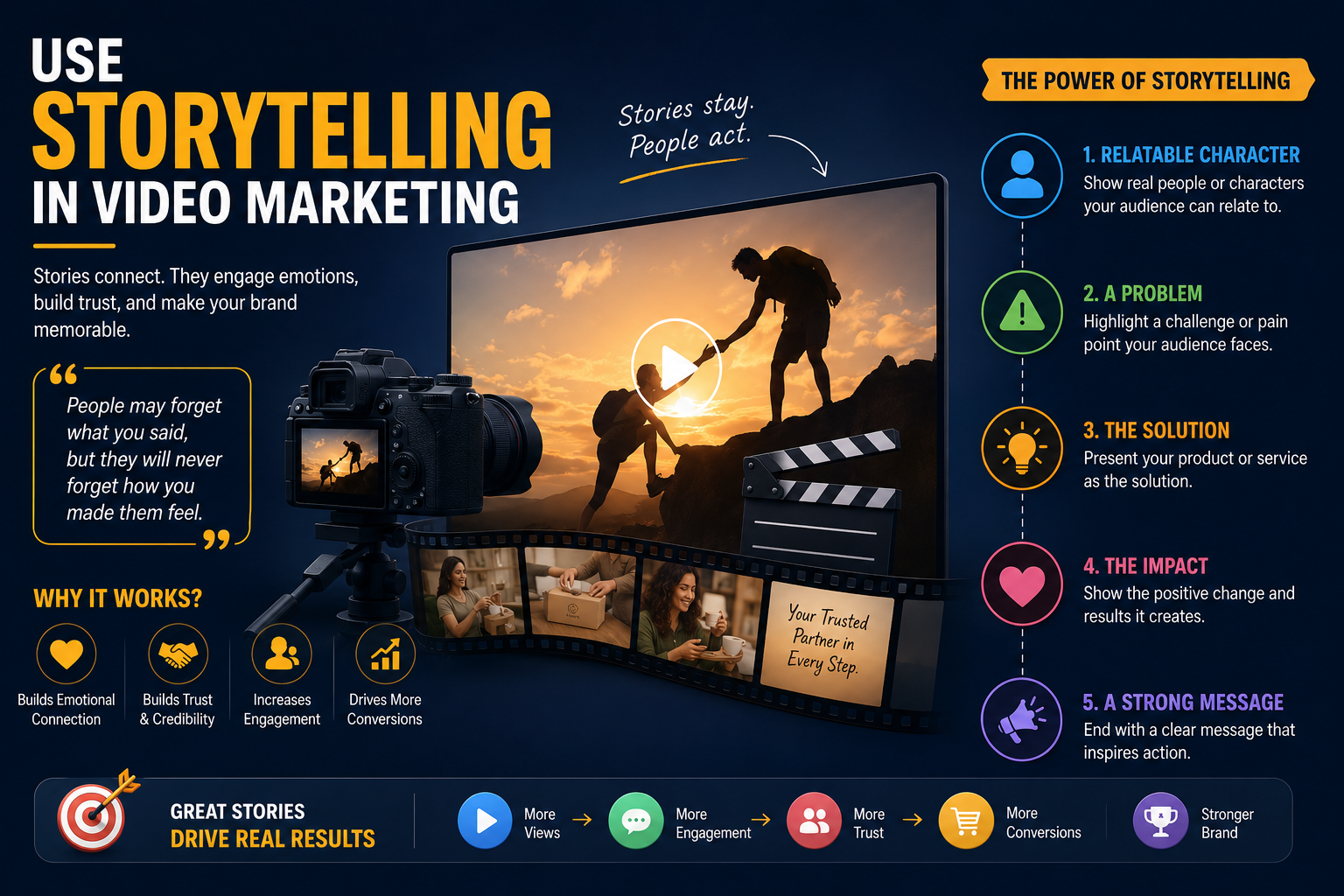 Storytelling can make video content more memorable. Instead of simply listing product features, businesses can explain how the product solves a real customer problem.
A simple storytelling structure can include:
Problem → Solution → Result
First, introduce a problem faced by the customer. Then show how the product or service provides a solution. Finally, demonstrate the result or benefit.
Storytelling can create an emotional connection between the audience and the brand.
Optimize Videos for Social Media
Different platforms have different audiences and content formats. Businesses should adapt their videos based on the platform they are using.
Instagram is highly effective for short-form and visually attractive videos. YouTube is suitable for both short and long-form educational content. Facebook can be useful for community-focused content and advertisements, while LinkedIn is particularly valuable for professional and B2B video content.
Businesses should also consider video dimensions, captions, thumbnails, titles, descriptions, and hashtags.
Video SEO for Businesses
Video SEO can help businesses improve the visibility of their videos in search results.
Businesses can optimize videos by using relevant keywords in titles, descriptions, captions, and supporting content.
For example, a company targeting the keyword “Video Marketing Strategy for Businesses” can naturally include the keyword in the video title, description, blog content, and related social media posts.
Businesses should avoid keyword stuffing. Keywords should be used naturally while keeping the content useful and easy to understand.
Use Calls-to-Action
Every marketing video should have a clear purpose. A call-to-action tells viewers what they should do next.
Examples include:
- Visit our website
- Contact us today
- Download our guide
- Subscribe to our channel
- Follow us on social media
- Shop now
- Book a consultation
- Learn more
A strong call-to-action can help convert video viewers into potential customers.
Promote Videos Across Multiple Channels
Creating a great video is only the first step. Businesses also need to promote their content.
A single video can be repurposed into multiple pieces of content. For example, a long YouTube video can be converted into several short videos for Instagram Reels, YouTube Shorts, and Facebook.
Important promotional channels include:
- YouTube
- Business websites
- Email marketing
- Online advertisements
Repurposing content can save time while allowing businesses to reach different audiences.
Measure Video Marketing Performance
Businesses should regularly analyze their video performance to understand what works and what does not.
Important metrics include:
- Video views
- Watch time
- Engagement rate
- Likes and comments
- Shares
- Click-through rate
- Website traffic
- Leads generated
- Conversion rate
For example, if a video receives many views but very few clicks, the business may need to improve its call-to-action. If viewers leave within the first few seconds, the opening hook may need improvement.
Data allows businesses to continuously improve their video marketing strategy.
Common Video Marketing Mistakes Businesses Should Avoid
Businesses can make several mistakes when creating video content, especially when they do not have a clear Video Marketing Strategy for Businesses. Avoiding these common mistakes can help brands create more engaging content and achieve better marketing results.
One common mistake is focusing too much on selling. Audiences usually prefer content that provides value, solves problems, educates, or entertains them. Instead of making every video a direct advertisement, businesses should focus on building trust and providing useful information to their target audience.
Another mistake is inconsistent posting. Posting videos randomly can make it difficult for businesses to build a regular audience. Businesses should develop a realistic content schedule and maintain consistency across their chosen platforms.
Poor audio quality is another common problem. Even if a video looks professional, unclear or distracting audio can make viewers leave quickly. Businesses should use clear audio and make sure that voiceovers, background music, and other sounds are properly balanced.
Businesses should also avoid making videos unnecessarily long. The ideal video length depends on the platform, audience, and purpose of the content. However, every second should provide value and keep the viewer interested.
Another important mistake is ignoring the target audience. A video may look attractive, but if it does not address the audience’s needs, interests, or problems, it may not generate meaningful engagement. Understanding the target audience should therefore be an important part of a Video Marketing Strategy for Businesses.
Businesses should also avoid weak calls to action. Every marketing video should guide viewers toward the next step, such as visiting a website, contacting the business, subscribing to a channel, downloading a resource, or making a purchase.
Finally, businesses should not focus only on views and likes. A successful video marketing campaign should also consider engagement, leads, conversions, website traffic, and return on investment.
By avoiding these mistakes and continuously improving their content, businesses can create a stronger Video Marketing Strategy for Businesses that builds audience trust, increases engagement, and supports long-term business growth.The Role of AI in Video Marketing
Artificial intelligence is changing the way businesses create video content. In a Video Marketing Strategy for Businesses, AI tools can help with script writing, video editing, captions, voiceovers, subtitles, content ideas, and personalization.
Businesses can use AI to speed up repetitive tasks and produce content more efficiently. When used effectively, AI can make a Video Marketing Strategy for Businesses more efficient and help brands create engaging content consistently.
However, human creativity and strategy are still important. AI should be used as a supporting tool rather than replacing the brand’s unique voice, creativity, and connection with its audience.
Create a Video Content Calendar
A content calendar can help businesses organize their video marketing activities and maintain consistency. As part of a Video Marketing Strategy for Businesses, a content calendar makes it easier to plan video topics, publishing dates, platforms, and content formats in advance.
A weekly video content plan might include:
Monday: Educational video
Wednesday: Product or service video
Friday: Customer testimonial
Sunday: Entertaining or behind-the-scenes video
Businesses can also include other types of content, such as how-to videos, product demonstrations, frequently asked questions, industry tips, promotional videos, and short-form social media content.
The exact schedule depends on the business, target audience, marketing goals, and platforms being used. For example, a business targeting younger audiences may focus more on short-form videos for Instagram and YouTube, while a B2B company may create more educational and professional content for LinkedIn.
A well-planned content calendar also helps businesses avoid last-minute content creation and maintain a regular publishing schedule. The main objective is to maintain consistency while providing valuable and engaging content to the target audience.
By planning content in advance and reviewing performance regularly, businesses can make their Video Marketing Strategy for Businesses more organized, consistent, and effective.
Conclusion
A well-planned Video Marketing Strategy for Businesses can help brands attract new customers, increase engagement, build trust, and improve conversions. From short-form social media videos to educational YouTube content and customer testimonials, businesses have many opportunities to connect with their target audience through video.
The key to successful video marketing is not simply producing more videos. Businesses need to create relevant and valuable content, understand their audience, choose the right platforms, use strong hooks and calls-to-action, optimize their videos for search, and continuously analyze performance.
As digital platforms continue to prioritize video content, businesses that develop a strong and consistent video marketing strategy can gain a significant advantage in the competitive online marketplace. Whether a business is small or large, video marketing can become an important part of its overall digital marketing strategy when it is planned and executed effectively.
What Is a Video Marketing Strategy?
A video marketing strategy is a planned approach to creating, publishing, and promoting videos to achieve specific business goals. Instead of creating videos randomly, businesses develop content based on their target audience, marketing objectives, platforms, and customer journey.
A successful Video Marketing Strategy for Businesses combines creativity with clear goals and performance measurement.
Why Is Video Marketing Important for Businesses?
Video can communicate information quickly while combining visuals, audio, storytelling, and emotion. This makes it useful for both building brand awareness and promoting products or services.
Some key benefits include:
- Increases brand awareness: Videos can introduce your brand to new audiences.
- Improves engagement: People are more likely to interact with interesting visual content.
- Builds trust: Product demonstrations, customer testimonials, and behind-the-scenes videos can make a brand feel more authentic.
- Supports conversions: Well-designed videos can encourage viewers to visit a website, contact a business, or make a purchase.
- Improves social media presence: Short-form videos can help businesses stay active on social platforms.
- Explains complex products: Tutorials and demonstrations can make difficult concepts easier to understand.
How to Create a Video Marketing Strategy for Businesses
1. Define Your Marketing Goals
Before creating a video, decide what you want to achieve. Your goal could be:
- Increasing brand awareness
- Generating leads
- Driving website traffic
- Promoting a product
- Increasing sales
- Educating customers
- Improving customer engagement
A clear goal helps you choose the right video format and measure its success.
2. Understand Your Target Audience
Your videos should be created for a specific audience rather than everyone.
Research your audience’s:
- Age
- Location
- Interests
- Problems
- Buying behaviour
- Preferred social media platforms
Understanding your audience helps you create videos that are relevant and useful.
3. Choose the Right Video Content
Different types of videos can support different marketing objectives.
Popular business video formats include:
- Product demonstration videos
- Explainer videos
- Tutorial videos
- Customer testimonial videos
- Behind-the-scenes videos
- Educational videos
- Promotional videos
- Short-form videos
- Live videos
- Company introduction videos
For example, a perfume business could create cinematic product videos, customer reviews, fragrance guides, and short promotional Reels.
4. Choose the Right Platforms
Not every video needs to be published on every platform.
Instagram: Reels, Stories, product videos and short-form content.
YouTube: Tutorials, reviews, educational videos and long-form content.
Facebook: Promotional videos, community content and advertisements.
LinkedIn: Professional, educational and company-related videos.
Choose platforms based on where your target audience spends time.
5. Create an Effective Video
A successful marketing video usually needs a strong structure:
Hook → Problem → Solution → Value → Call to Action
The first few seconds are especially important because viewers can quickly scroll past content that doesn’t capture their attention.
For example:
“Struggling to find a perfume that lasts all day?”
Then introduce the product, demonstrate its benefits, and finish with a clear call to action such as “Shop Now” or “Learn More.”
6. Use Storytelling
Storytelling can make business videos more memorable. Instead of simply listing product features, show how the product or service solves a real problem.
A simple storytelling structure is:
Problem → Journey → Solution → Result
This approach can create an emotional connection between the audience and the brand.
7. Optimize Videos for Search
Video content can also support SEO. Use relevant keywords in:
- Video titles
- Descriptions
- Captions
- Hashtags
- Thumbnail text
- Supporting blog content
For example, a business targeting the keyword “Video Marketing Strategy for Businesses” can create a video with that phrase naturally included in its title and description.
8. Add a Strong Call to Action
Every marketing video should have a clear next step.
Examples include:
- Visit our website
- Shop now
- Contact us
- Subscribe
- Follow us
- Download the guide
- Book a consultation
A clear CTA helps turn video views into meaningful business actions.
Measure and Analyze Video Marketing Performance
Creating videos is only one part of a successful Video Marketing Strategy for Businesses. Businesses should regularly analyze the performance of their video content to understand what is working and what needs improvement. Tracking the right metrics helps businesses make better decisions and create more effective video campaigns.
Important metrics include:
Video views – Shows how many people watched the video.
Watch time – Helps measure how long viewers stayed engaged with the content.
Engagement – Includes likes, comments, shares, and other interactions.
Click-through rate – Shows how many viewers clicked on a link or button after watching the video.
Conversion rate – Measures how effectively the video encourages viewers to take the desired action.
Leads generated – Shows how many potential customers came from the video.
Cost per view – Helps businesses understand how much they are spending to generate each video view.
Return on investment (ROI) – Helps measure whether the video marketing campaign is generating a positive business return.
Regular performance analysis is an important part of a Video Marketing Strategy for Businesses because it helps identify successful content and areas that need improvement. If one type of video performs better than another, businesses can use those insights to improve future content.
For example, if short videos receive higher engagement than longer videos, a business can create more short-form content. Similarly, if tutorial or product demonstration videos generate more leads, businesses can focus on producing similar content.
By continuously monitoring performance, testing different video formats, and making data-driven improvements, businesses can create a more effective Video Marketing Strategy for Businesses and achieve better engagement, leads, conversions, and overall marketing results.
Common Mistakes to Avoid in a Video Marketing Strategy for Businesses
Businesses should avoid:
Creating videos without a clear goal or marketing objective
Making the introduction too long and losing viewers’ attention
Ignoring the target audience and their interests
Using poor-quality audio or visuals
Adding too much information in a single video
Forgetting to include captions and subtitles
Using weak or unclear calls to action
Focusing only on views instead of conversions and business results
Posting videos inconsistently without following a proper content schedule
Failing to align video content with the overall Video Marketing Strategy for Businesses
Conclusion
A well-planned Video Marketing Strategy for Businesses can help companies build brand awareness, connect with their target audience, and drive business growth. The key is to understand your audience, create valuable content, select the right platforms, use strong storytelling, and continuously measure performance.
Video marketing is not simply about creating attractive videos. It is about creating the right video, for the right audience, on the right platform, with the right goal. When businesses follow a strategic approach, video can become a powerful part of their overall digital marketing strategy.
auther: jishad rahman