


In today’s digital world, businesses are using social media not only to promote their products and services but also to understand their customers. Platforms such as Instagram, Facebook, YouTube, LinkedIn, and TikTok generate valuable data about audience behaviour, content performance, engagement, and conversions.
However, simply posting content on social media is not enough. Businesses need to understand whether their content is actually achieving their marketing goals. This is where a Social Media Analytics Strategy for Businesses becomes important.
A well-planned Social Media Analytics Strategy for Businesses helps businesses collect data, measure performance, understand their audience, identify successful content, and make better marketing decisions. By analyzing social media data effectively, businesses can improve their content strategy, increase engagement, and achieve better marketing results.
What Is Social Media Analytics?
Social Media Analytics Strategy for Businesses involves the process of collecting, measuring, and analyzing data from social media platforms to understand marketing performance. It helps businesses track important metrics such as engagement, reach, impressions, clicks, conversions, and audience growth.
By using social media analytics, businesses can identify what type of content performs best, understand audience preferences, and make data-driven marketing decisions.

It helps businesses answer important questions such as:
- How many people are seeing our content?
- Which posts are getting the most engagement?
- Who is our target audience?
- Which platform performs best?
- What type of content generates the most interest?
- How much traffic comes from social media?
- Are social media campaigns generating leads or sales?
Instead of making marketing decisions based only on assumptions, businesses can use real data to improve their strategies.
Why Is Social Media Analytics Important for Businesses?
 A strong Social Media Analytics Strategy for Businesses provides several important benefits.
1. Understand the Target Audience
Analytics provides information about the people interacting with a brand.
Businesses can learn about:
- Age groups
- Locations
- Gender distribution
- Interests
- Active times
- Device usage
- Content preferences
This information helps marketers create content that is more relevant to their audience.
2. Measure Content Performance
Not every social media post will perform equally. A Social Media Analytics Strategy for Businesses helps identify which types of content perform best and which posts need improvement.
Analytics can show which content receives the most:
-
Likes
-
Comments
-
Shares
-
Saves
-
Views
-
Clicks
-
Engagement
For example, if educational Reels consistently receive more engagement than promotional posts, a business may decide to create more educational video content. By using a Social Media Analytics Strategy for Businesses, companies can analyze content performance and create content that better matches their audience’s interests.
3. Improve Marketing Decisions
Without analytics, businesses may continue using strategies that do not produce results. A Social Media Analytics Strategy for Businesses helps marketers understand which strategies are working and which areas need improvement.
Data helps marketers identify what is working and what needs improvement. By analyzing social media performance, businesses can make data-driven decisions, improve their content, and achieve better marketing results.
This creates a continuous process:
Create → Publish → Measure → Analyze → Improve → Repeat
Following this process allows businesses to continuously improve their Social Media Analytics Strategy for Businesses and achieve their social media marketing goals.
4. Track Business Goals
Social media analytics is not only about likes and followers. A Social Media Analytics Strategy for Businesses helps companies measure whether their social media activities are actually contributing to important business goals.
Businesses can also measure whether social media contributes to:
-
Website traffic
-
Leads
-
Sales
-
App downloads
-
Sign-ups
-
Customer inquiries
This makes social media marketing more closely connected to business objectives. By using a Social Media Analytics Strategy for Businesses, companies can measure real business results and understand how their social media efforts contribute to overall growth.
Important Social Media Metrics for Businesses
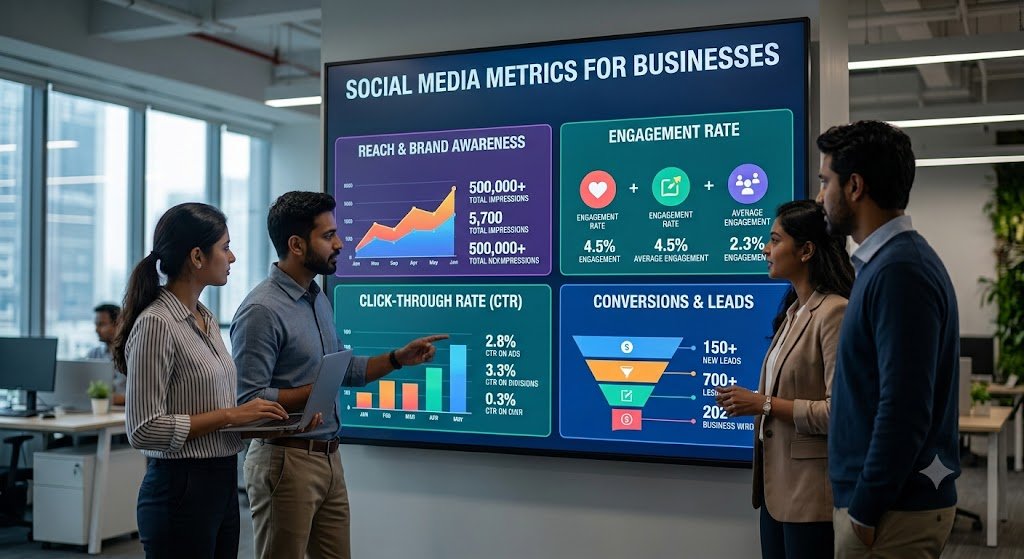 Understanding the right metrics is an essential part of building a Social Media Analytics Strategy for Businesses.
Reach
Reach refers to the number of unique people who have seen your content.
For example, if your Instagram post reaches 10,000 people, approximately 10,000 unique accounts were exposed to that content.
Reach is particularly useful for measuring brand awareness.
Impressions
Impressions represent the number of times content has been displayed.
One person can generate multiple impressions.
For example, if one user sees your post three times, that may count as three impressions but one person in reach.
Engagement Rate
Engagement rate measures how actively people interact with your content.
Engagement can include:
- Likes
- Comments
- Shares
- Saves
- Clicks
A high engagement rate often indicates that content is relevant to the audience.
Follower Growth
Follower growth shows whether your social media audience is increasing or decreasing over time.
However, businesses should not focus only on the number of followers. A smaller audience that actively engages and purchases can be more valuable than a large audience with little interest in the brand.
Click-Through Rate
Click-through rate, or CTR, measures the percentage of users who click a link or advertisement after seeing it.
CTR can help businesses understand how effectively their content encourages people to take the next step.
Conversion Rate
Conversion rate measures how many users complete a desired action.
Examples include:
- Making a purchase
- Filling out a form
- Booking a service
- Signing up for a newsletter
- Downloading an ebook
This metric is especially important for businesses focused on generating revenue.
How to Create a Social Media Analytics Strategy for Businesses
 1. Define Clear Goals
The first step is to determine what you want social media to achieve.
Your goals could include:
- Increasing brand awareness
- Growing followers
- Increasing engagement
- Generating leads
- Driving website traffic
- Increasing sales
- Improving customer service
For example, a new business may focus on brand awareness, while an established e-commerce company may focus on sales and conversions.
Clear goals make it easier to select the right metrics.
2. Choose the Right Metrics
Do not try to measure every available metric.
Choose metrics that are directly connected to your goals.
For example:
|
Goal |
Important Metrics |
|
Brand Awareness |
Reach, Impressions, Views |
|
Engagement |
Likes, Comments, Shares, Saves |
|
Website Traffic |
Link Clicks, CTR |
|
Lead Generation |
Leads, Conversion Rate |
|
Sales |
Purchases, Revenue, ROAS |
|
Audience Growth |
Followers, Follower Growth |
This helps businesses focus on meaningful data rather than unnecessary numbers.
3. Select the Right Social Media Platforms
Different platforms may produce different results depending on the business and target audience.
For example:
Instagram can be useful for visual content, Reels, products, and lifestyle brands.
YouTube can be useful for tutorials, educational videos, product reviews, and long-form content.
LinkedIn can be useful for B2B businesses, professional content, and industry expertise.
Facebook can support community building, advertising, and content distribution.
Businesses should analyze each platform separately rather than assuming that one strategy will work everywhere.
4. Track Content Performance
Businesses should regularly analyze individual pieces of content.
Ask:
- Which posts received the highest engagement?
- Which videos generated the most views?
- Which posts received the most saves?
- Which content generated website clicks?
- Which topics attracted the most attention?
For example, imagine a clothing brand publishes:
- Product photos
- Styling tips
- Customer reviews
- Behind-the-scenes videos
- Promotional posts
After analyzing the data, the business discovers that styling videos receive the most shares and saves.
The company can then increase the amount of styling content in its content strategy.
5. Analyze Your Audience
Audience analytics can help businesses understand when and how people interact with their content.
Important information includes:
- Audience age
- Location
- Gender
- Active hours
- Interests
- Device usage
For example, if analytics show that most followers are active between 7 PM and 10 PM, the business can test publishing content during that period.
However, businesses should experiment rather than blindly following analytics. Performance should be compared over time to identify consistent patterns.
6. Analyze Competitors
Social media analytics can also help businesses understand their competitive environment.
Businesses can examine:
- Competitor content types
- Posting frequency
- Engagement patterns
- Popular topics
- Video formats
- Audience reactions
The goal should not be to copy competitors.
Instead, competitor analysis can reveal opportunities for differentiation.
For example, if competitors mostly publish promotional content, a business might differentiate itself through educational content, tutorials, customer stories, or behind-the-scenes videos.
7. Track Paid Social Media Campaigns
Businesses running social media advertisements need to analyze paid campaign performance separately from organic content.
Important advertising metrics include:
- Impressions
- Reach
- Clicks
- CTR
- Cost per click
- Cost per result
- Conversion rate
- Return on ad spend
If an advertisement receives thousands of impressions but very few clicks, the creative, targeting, offer, or CTA may need improvement.
8. Use A/B Testing
A/B testing involves comparing two versions of content to determine which performs better.
Businesses can test:
- Headlines
- Images
- Videos
- Captions
- CTAs
- Offers
- Audience segments
- Ad creatives
For example:
Ad A: “Shop Our New Collection”
Ad B: “Discover Your New Everyday Style”
If Ad B generates significantly more clicks or conversions, the business gains useful information about the messaging that resonates with its audience.
Social Media Analytics Tools
Businesses can use several tools to collect and analyze social media data.
Native Platform Analytics
Social platforms provide their own analytics systems.
These can provide information about:
- Content performance
- Audience demographics
- Reach
- Engagement
- Views
- Followers
- Advertising performance
Google Analytics
Google Analytics can help businesses understand what happens after users visit a website from social media.
For example, marketers can analyze:
- Traffic sources
- Landing pages
- User behaviour
- Conversions
- Campaign performance
Social Media Management Tools
Businesses can also use third-party platforms to manage multiple social accounts and analyze performance from one dashboard.
The best tool depends on the company’s size, budget, platforms, and reporting requirements.
Creating a Social Media Analytics Report
A social media analytics report summarizes marketing performance over a specific period.
A monthly report could include:
1. Overview
- Total reach
- Total impressions
- Engagement
- Follower growth
2. Top Performing Content
Identify the posts, videos, or campaigns that performed best.
3. Audience Insights
Show important demographic and behavioural information.
4. Website Performance
Include traffic and conversions generated through social media.
5. Paid Advertising
Report:
- Ad spend
- Clicks
- Conversions
- Cost per result
- Revenue
6. Recommendations
The most valuable part of a report is explaining what should happen next.
For example:
“Short-form educational videos generated significantly higher engagement than static promotional posts. The next month’s strategy should increase educational video content.”
This turns data into an actionable strategy.
Common Social Media Analytics Mistakes
Businesses often make several mistakes when analyzing social media.
Focusing Only on Followers
Follower count is useful, but it does not automatically mean business success.
Engagement, leads, conversions, and revenue can be more meaningful.
Tracking Too Many Metrics
Tracking dozens of metrics can make reports confusing.
Focus on metrics connected to your goals.
Ignoring Negative Performance
Poor-performing content can also provide valuable information.
It can help businesses understand what their audience does not respond to.
Looking at Data Only Once
Analytics should be reviewed regularly.
Weekly, monthly, and quarterly analysis can reveal trends that individual posts cannot show.
Not Taking Action
Collecting data is useless if businesses do not use it to improve their strategy.
The purpose of analytics is to turn data into decisions.
How Social Media Analytics Improves Marketing Strategy
Analytics should influence future marketing decisions.
For example:
Data: Reels receive higher engagement than static posts.
Insight: The audience prefers short-form video content.
Action: Increase the number of Reels.
Result: Compare future performance.
This creates a continuous improvement cycle:
Data → Insight → Action → Measurement → Optimization
Over time, this approach can help businesses create more effective social media campaigns.
The Future of Social Media Analytics
Social media analytics is becoming increasingly advanced.
Artificial intelligence and automation can help marketers identify patterns, predict trends, analyze large amounts of data, and understand audience behaviour.
Businesses may increasingly use AI to:
- Identify high-performing content
- Predict audience interests
- Analyze sentiment
- Automate reporting
- Discover trends
- Personalize content
- Improve advertising campaigns
However, human judgment will remain important. Data can show what happened, but marketers still need to understand why it happened and what action should be taken.
Conclusion
A strong Social Media Analytics Strategy for Businesses helps companies move beyond simply posting content and hoping for results. It provides a structured way to understand audiences, measure performance, identify opportunities, and improve marketing decisions.
The process begins with clear goals and relevant metrics. Businesses can then track content performance, analyze their audience, compare platforms, measure advertising results, conduct A/B testing, and create regular reports. By following a Social Media Analytics Strategy for Businesses, companies can make informed decisions based on real performance data.
The most important lesson is that social media analytics is not just about collecting numbers. It is about turning data into actionable insights.
When businesses consistently analyze their social media performance and use those insights to improve their content and campaigns, they can build stronger relationships with their audience, improve marketing efficiency, generate more leads, and ultimately support long-term business growth. A well-planned Social Media Analytics Strategy for Businesses makes it easier to continuously measure, optimize, and improve social media marketing efforts.
auther:jishadrahman